24 hours at Mount Fuji : it’s very accessible as it’s just 1h30 from Tokyo by train. But here’s the thing — I strongly recommend staying one night. And by the end of this article, you’ll understand why.
We stopped at Mount Fuji on our way from Tokyo to Kyoto. It wasn’t part of the original plan — we just decided the night before. And it turned out to be one of the most beautiful stops of the whole trip.
In this article, I’m sharing our full 24-hour itinerary: how to get there, where to cycle, where to eat, my best tips to actually see the mountain, and where to sleep with a view.
This post may contain affiliate links, please read our privacy policy for details.
You’re in a hurry ?
BEST THINGS TO DO: Chureito Pagoda | Oshino Hakkai | Cycling around the lake | Yamanaka Terrace | CYCL Sauna (with Mt Fuji view)
BEST PLACES TO STAY:
Quick FAQs
Is one day enough at Mount Fuji? It’s possible as a day trip, but I strongly recommend staying one night. It doubles your chances of seeing Mt Fuji.
What is the best time to visit Mount Fuji? October to February for dry, clear air and snow on the summit. Autumn is especially beautiful with autumn leaves.
How do I get from Tokyo to Mount Fuji? From Shinjuku Station. Express bus is the fastest (1h30, ~2,500 ¥). Train takes about 2 hours.
Can you cycle around Lake Yamanaka? Yes! The loop is about 25km, flat and very manageable. Dedicated bike lane so it’s very safe.
How do I know if Mount Fuji will be visible? Check fuji-san.info the day before.
When Is the Best Time to See Mount Fuji?
Here’s something I didn’t know before arriving in Japan: Mount Fuji is not always visible.
I genuinely thought you could see it all the time. But that’s actually what makes it so special — you have to earn it. The main reason is humidity. When the air is humid, clouds form around the mountain and hide it completely. This happens a lot in spring and summer.
The stats are pretty surprising. On average, Mount Fuji is clearly visible only about 80 days per year. In August, the mountain is visible on fewer than 6 days. And a lot of travelers come back from Japan without ever seeing it.
So here’s how to maximize your chances:
Visit in autumn or winter. In October, visibility jumps to 61%. In December and January, it reaches over 75% — the best months of the year. The air is dry, cold, and clear. Eventually you’ll see some snow on top.
Check the visibility app before you go. fuji-san.info shows you the current weather and visibility around the mountain. I checked it the day before we left Tokyo and it looked good. Worth doing every time.
Stay one night. A day trip is possible, but it’s short on time and risky. If the mountain is hidden when you arrive, you have no second chance. With one night, you wake up the next morning with another opportunity — and in my experience, taking the time to enjoy the moment is more important than just ticking a place.
My Tips
I went in late October and had clear blue sky both days. My sister visited in spring, and only caught a glimpse of Fuji from the train window, she clearly didn’t get the same experience.
How to Get TO MOUNT FUJI from Tokyo ?
All routes to Mount Fuji start from Shinjuku Station. The main hub you’re heading to is the city of Fujiyoshida — that’s where the trains and buses arrive, and where you can rent your bikes.
Option 1: Train (what I did)
Shinjuku → Otsuki (JR Chuo Line) → Fujiyoshida (Fujikyu Line). Takes about 2 hours total. It’s not the fastest option — we booked the night before and so we didn’t make research much research. But honestly, it’s still a beautiful journey and doesn’t double the time neither.
Option 2: Express Highway Bus (fastest, recommended)
From Shinjuku Expressway Bus Terminal → to Fuji Q / Fujiyoshida. It takes about 1h30 and roughly 2,500 ¥. This is the easiest, cheapest and most direct option.
Option 3: Guided Tour from Tokyo
If you’d rather not deal with all the logistics to get there, these tours include everything:
→ Mt Fuji Top 5 Spots Day Tour: Arakurayama Park,Oshino Hakkai
→ Tokyo : Mont Fuji, parc d’Oishi, lac Kawaguchi et Oshino Hakkai
→ Ascension du mont Fuji en 2 jours avec accès à la 8e station et guide anglophone
My Tips
Use both Google Maps and the app Plan (on iPhone only) to check directions. I noticed that depending on the area, one can be more accurate than the other — so it’s worth comparing both before choosing your route.
Where to Stay Around Lake Yamanaka
Most accommodations here offer views of the lake, Mount Fuji, or both. I’d recommend you filtering for 8/10+ on Booking.
Here are my suggestions:
Mid Budget : Hatago Tsubakiya or Kounso
High Budget : Stay Villa with Mt Fuji View
More Japan Articles:
→12 Things That Will Surprise You When You Arrive in Japan
→How to Get from Narita Airport to Tokyo
→The Suica Card: Everything You Need to Know
→Japanese Food Guide: What to Eat and Where

Day by Day
Day 1: Arriving at Mount Fuji
Morning — Shinjuku to Fujiyoshida
We left early from Shinjuku after a quick bite at the station. There’s a sushi spot right there — fast, cheap, and perfect before a long journey. No time to waste.
I’ll be honest: on the train, I kept looking out the window hoping to spot Mount Fuji. At the stop just before Fujiyoshida, you can catch a glimpse — but it wasn’t fully visible yet. And arriving at the station, still no clear view. A little anticlimactic, but I knew it could change.
Afternoon — Bikes, Fuji Streets & the Moment I’ll Never Forget
First stop at Fujiyoshida Station: leave your luggage in the lockers right outside. They’re super convenient and have large sizes for big suitcases. Here. Then rent a bike. There are is a rental spot right near the station exit: Here (3000JPY/a day ≈ 16euros)
We started cycling toward the most famous street in Fujiyoshida — a long straight road that frames Mount Fuji perfectly at the end. You’ve probably seen it in photos. Here
And… still not fully visible. Clouds were still around the summit. Then, about 5 minutes later, I turned around on my bike while going down the street. And there it was!
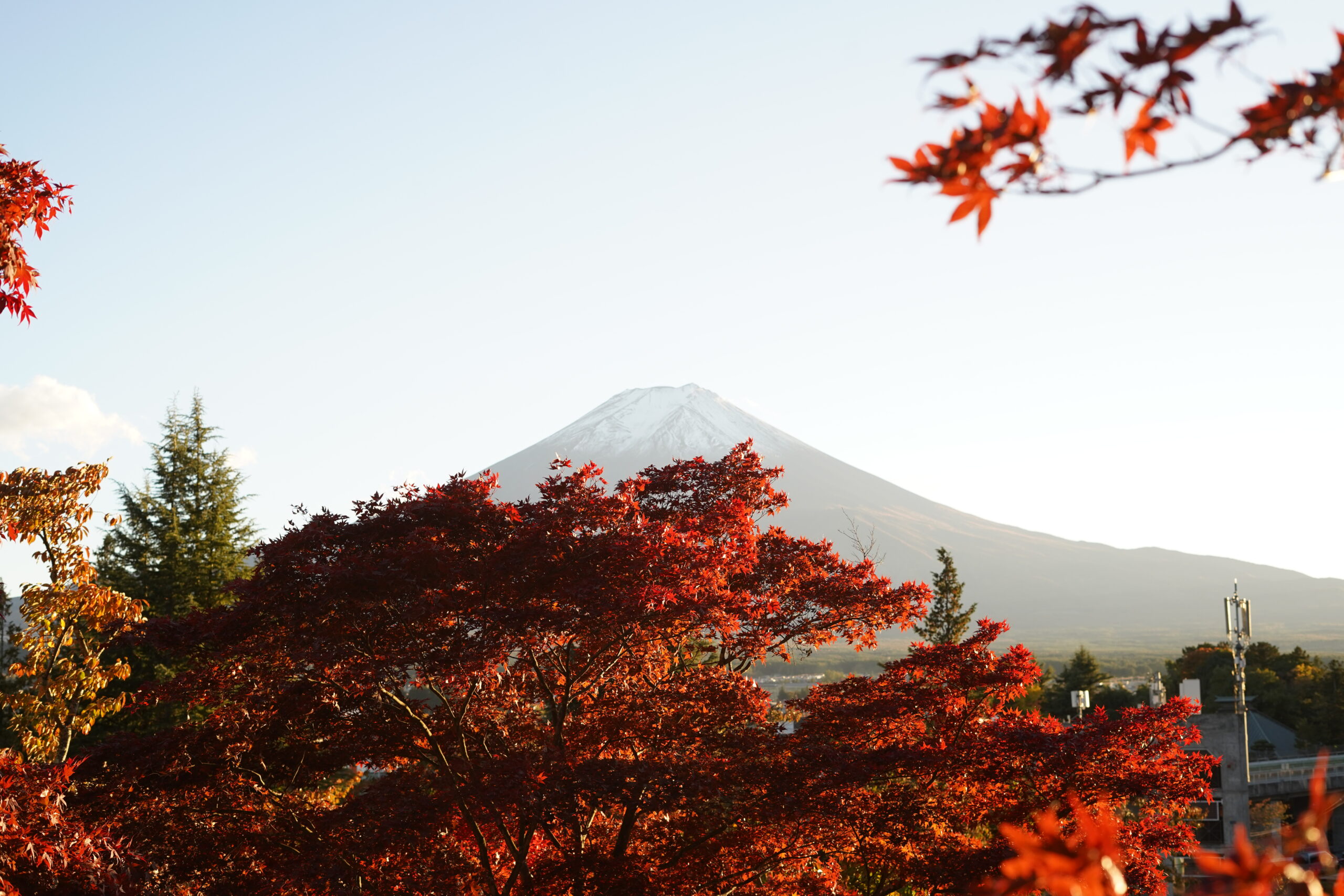
Mount Fuji. Clear, snow-capped (it snowed few weeks ago), massive. Just sitting there like it had been waiting for me the whole time. I was so excited.
Right next to that spot, there are two great places to stop:
FabCafé Fuji (Here)— beautiful design, great cakes, perfect for a morning coffee after the ride.
And if you’re more into Japanese sweets, there’s also this place (Here) where you can get dorayaki — don’t miss my full guide to Japanese food if you want to know what that is.
And right across the street: here with the most stylish souvenirs I found in all of Japan. Not a typical touristy shop — it’s actually good design pieces.
After that magical moment, we cycled to the Chureito Pagoda — probably the most photographed spot in Japan.
A quick bit of history: the pagoda was built in 1963 as a memorial for the 960 citizens of Fujiyoshida who died in war, from the First Sino-Japanese War through to World War II. It is part of the Arakura Sengen Shrine. The shrine itself dates back to 705 AD.
To reach the pagoda, you climb 398 stone steps up the hillside. But the view at the top — the red pagoda on one side, Mount Fuji in the background, red and orange autumn leaves everywhere — was absolutely worth the steps. (It is very touristy though)
Evening — Getting to the Lake
After returning our bikes, we took the bus to our accommodation at Lake Yamanaka. It takes about 40-50 minutes and costs around 910 ¥ (roughly €5). You can take 2 buses or find a direct one — check both Google Maps and Apple Maps to compare, as I mentioned.
We arrived in the early evening. Quiet atmosphere, very different after the bustling Tokyo. It felt so good.
Day 2: Waking Up with Mount Fuji
Morning — The View We Came For
We woke up to Mount Fuji right outside the window. When you see this you realize why you stayed one night here. It was beautiful.
Most accommodations around Lake Yamanaka offer this kind of view — some more directly than others.
We walked to the bike rental at the lake: Here
Morning Ride: BREAKFAST IN THE FOREST AND CYCLING Around the Lake
Hop on the bike and go.
What’s amazing and why we decided to pick Lake Yamanaka is because there is a proper cycle lane all around the lake. It was really calm and we met almost no-one on it, while people were few meters at one spot.
One spot I liked also was the tennis courts right by the water. Here. The contrast of the green courts with Mount Fuji in the background are perfect for photo lovers and also nice to see Mt Fuji from a different perspective.
Yamanaka Terrace Café (here) is a forest café with such a most beautiful design and environment — raw wood high tables, concrete on the floor and all that surrounded by trees. (Check their Website)
This is my top recommendation for anyone going to Mount Fuji who wants to escape from the crowd
I eat savoury in the morning so I went for a rice and curry. But they also have coffee, orange juice, pastries — plenty of options. Sitting there, in the forest, with Mount Fuji in the distance and autumn leaves all around… one of those moments where you just feel completely at peace.